
- Home
- Sustainability
- Sustainable Finance
Sustainable Finance
API invests primarily in urban retail and Tokyo office properties. API seeks to increase unitholder value by building and operating a portfolio of properties that are competitive in the medium to long term. To build a portfolio with a stable and sustainable demand from our customers, we believe that in addition to the location, use, scale, and quality of properties, reducing our environmental footprint and contributing to the surrounding communities and environment are important.
API aims to further promote its sustainability initiatives through issuance of green bonds and invite new investors to its investment corporation bonds by stimulating their demand who have interest in ESG investment.
Activia Properties Inc. (“API”) aims to further promote its sustainability initiatives through issuance of the green bonds, and invite new investors to its investment corporation bonds by stimulating their demand who have interest in ESG investment.
About Green Bonds
Green bonds are a type of bond instruments where the proceeds will be exclusively applied to finance or refinance green projects such as countermeasures against global warming or businesses with environmental benefits and that are
generally aligned with the Green Bond Principles, a voluntary guideline of International Capital Market Association (ICMA).
For details, please refer to the ICMA’s website linked below.
ICMA Green Bond Principles (GBP)
API’s Green Bond Framework has been reviewed by Sustainalytics, an ESG rating agency, and received from them a second-party opinion with regard to the eligibility.
For details, please refer to the second-party opinion from Sustainalytics linked below.
Green Bond Framework
1.Use of proceeds
The proceeds from the green bonds will be allocated to funds for (i) acquisition of the Eligible Green Projects which are existing or new buildings fulfilling the item A of the Eligibility Criteria defined below, or (ii) refurbishments fulfilling the item B of the Eligibility Criteria, or (iii) refinancing the existing loans/investment corporation bonds which have been allocated to funds to acquire Eligible Green Projects or refurbishments.
2.Eligibility Criteria
The proceeds of the green bonds will be allocated to the projects that conform to one or more of the following criteria.
A. Eligible Green Projects
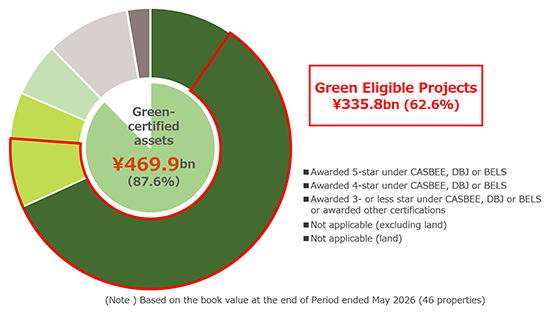
Buildings that have achieved the top two levels of one or more of the third-party green building certifications/recertifications listed below within 36 months prior to the payment date of green bonds or are expected to achieve:
- Certification for CASBEE for Real Estate (A or S Rank)
- DBJ Green Building Certification (4 or 5 Stars)
- BELS (4 or 5 Stars)
B. Refurbishments
Refurbishments with a primary purpose of achieving one of the targets listed below and are completed within 36 months prior to the payment date of green bonds or are expected to be completed:
- Refurbishments with more than 10% reduction in CO2 emissions or energy consumption
- Refurbishments with more than 10% reduction in water consumption
- New achievement of the top two levels of one or more of the green building certifications listed in above item A or one or more levels of star/rank improvement in such certifications
3.Management of proceeds
API calculates the amount of debts of Eligible Green Projects by multiplying the calculable total book value of the Eligible Green Projects* at end of the financial period immediately preceding each date of bond issuance by its LTV (Loan to Value / interest-bearing debt to total assets) ratio. API will then monitor to ensure that the total amount of unredeemed green bonds does not exceed the amount of debts of Eligible Green Projects.
As of May 31, 2026

* “Eligible Green Projects at the end of the financial period immediately preceding each date of bond issuance” refer to the buildings that have achieved the top two levels of one or more of the third-party green building certifications/recertifications within 36 months prior to the end of the financial period immediately preceding each date of bond issuance.
4.Reporting
As far as there is unallocated amount of funds, API will disclose on its website the list of financed/refinanced Eligible Green Projects and refurbishments, allocation status including the amount of unallocated proceeds, allocation schedule and managing method of net proceeds of green bonds at end of May each year. API also disclose that the amount of unredeemed green bonds does not exceed the amount of debts of the Green Eligible Projects. After the issuance, as long as there is an unredeemed balance of the green bonds, API will disclose the amount of total book value of the Eligible Green Projects and the amount of debts of Green Eligible Projects, as well as amount of unredeemed green bonds at end of May each year.
5.Impact Reporting
If there is unredeemed balance of green bonds, API will annually disclose the summary, progress and levels of certifications of the Eligible Green Projects. Additionally, API will annually provide the following indicators of the Eligible Green Projects where API has control over energy usage:
- Energy consumption
- CO2 emissions
- Water consumption
- Waste generation
To report the effects in environmental performance of refurbishments funded by the proceed of green bonds, API will provide estimated rate of reduction (%) in the amount of energy consumption, water consumption, and CO2 emissions before and after the refurbishment.
Green Bond Summary
| Total issue amount (¥million) | Interest rate | Offering date | Redemption date | Description | Press release | ||
|---|---|---|---|---|---|---|---|
| The 11th unsecured investment corporation bonds (green bonds) |
4,000 | 0.530% | November 18, 2019 | November 16, 2029 | [cannot shift グリーンボンド_項目6_E] | Notice Concerning Issuance of Investment Corporation Bonds (Green Bonds) | Notice Concerning Issuance of Investment Corporation Bonds (Green Bonds) |
| The 12th unsecured investment corporation bonds (green bonds) |
4,500 | 0.510% | October 21, 2020 | October 21, 2030 | [cannot shift グリーンボンド_項目6_E] | Notice Concerning Issuance of Investment Corporation Bonds (Green Bonds) | Notice Concerning Issuance of Investment Corporation Bonds (Green Bonds) |
| The 14th unsecured investment corporation bonds (green bonds) |
3,900 | 0.400% | November 16, 2021 | November 14, 2031 | [cannot shift グリーンボンド_項目6_E] | Notice Concerning Issuance of Investment Corporation Bonds (Green Bonds) | Notice Concerning Issuance of Investment Corporation Bonds (Green Bonds) |
| The 15th unsecured investment corporation bonds (green bonds) |
2,000 | 0.820% | December 19, 2022 | December 17, 2032 | [cannot shift グリーンボンド_項目6_E] | Notice Concerning Issuance of Investment Corporation Bonds (Green Bonds) | Notice Concerning Issuance of Investment Corporation Bonds (Green Bonds) |
| Total | 14,400 | ― | [cannot shift グリーンボンド_項目6_E] | ― | ― |
Impact Reporting
| Energy consumption per year (MWh) (Note 2) |
CO2 emissions per year (t-CO2) (Note 3) |
Water consumption per year (m3) | Waste generation per year (t) | ||||
|---|---|---|---|---|---|---|---|
| Actual | Scope 1 (direct emission) |
Scope 2 (indirect emission) |
Scope 3 (emission from tenants) |
||||
| FY2018 | 52,171 | 22,614 | - | - | - | 271,021 | 1,994 |
| FY2019 | 44,669 | 18,125 | - | - | - | 247,458 | 2,056 |
| FY2020 | 26,585 (60,318) |
22,963 | 58 | 11,077 | 11,828 | 226,405 | 1,913 |
| FY2021 | 16,261 (45,435) |
16,758 | 233 | 5,320 | 11,205 | 146,773 | 1,128 |
| FY2022 | 17,514 (47,691) |
14,636 | 208 | 5,647 | 8,781 | 162,352 | 1,171 |
| FY2023 | 14,225 (44,019) |
5,354 | 71 | 522 | 4,761 | 197,800 | 1,398 |
| FY2024 | 7,897 (25,118) |
3,498 | 16 | 1,757 | 1,725 | 136,822 | 1,076 |
| FY2025 | 24,160 (58,891) |
5,101 | 155 | 2,124 | 2,822 | 219,605 | 2,276 |
| (Note 1) | Principally the figures shown above are relevant to the amounts of consumption, emissions or generation from the Eligible Green Assets as of the end of May of the following year, based on the cumulative amounts for a fiscal year (from FY2018 to FY2024:from April to March, FY2025:from December to November) of the entire portfolio excluding lands. |
|---|---|
| (Note 2) | Total amount of consumption fuel (gas, heavy oil, etc.), electricity and district heating / cooling of the properties. From FY2020 onwards, the amount covers the area of the properties for which API has operational control of energy management. Figure in parentheses includes emissions by tenants, same as for FY2018 and FY2019. |
| (Note 3) | The factor and the method applied to the calculation conform to "GHG Emissions Accounting, Reporting and Disclosure System" of the Ministry of the Environment. From FY2020 onwards, figures reported for Scope 3 fall under category 13 and are limited to the data which were able to be collected from tenants. |
List of API's Green Eligible Projects
| Property no. |
Property name | Received ranks | Book value at the end of the period (¥ million) |
||
|---|---|---|---|---|---|
| DBJ Green Building Certification |
Certification for CASBEE for Real Estate |
BELS Certification |
|||
| UR-1 | Tokyu Plaza Omotesando “Omokado” | S(★★★★★) | 44,264 | ||
| UR-3 | Q plaza EBISU | S(★★★★★) | 8,020 | ||
| UR-10 | Q plaza SHINSAIBASHI | A(★★★★) | 13,279 | ||
| UR-12 | A-FLAG BIJUTSUKAN DORI | S(★★★★★) | 4,724 | ||
| UR-15 | DECKS Tokyo Beach | S(★★★★★) | 13,122 | ||
| UR-17 | Q plaza HARAJUKU | S(★★★★★) | 13,256 | ||
| TO-1 | TLC Ebisu Building | S(★★★★★) | 7,103 | ||
| TO-2 | A-PLACE Ebisu Minami | S(★★★★★) | 9,347 | ||
| TO-3 | A-PLACE Yoyogi | S(★★★★★) | 3,797 | ||
| TO-4 | A-PLACE Aoyama | S(★★★★★) | 8,604 | ||
| TO-7 | A-PLACE Ikebukuro | A(★★★★) | 3,503 | ||
| TO-9 | A-PLACE Gotanda | A(★★★★) | 5,158 | ||
| TO-11 | OSAKI WIZTOWER | S(★★★★★) | 9,998 | ||
| TO-12 | Shiodome Building | ★★★★★ | 69,566 | ||
| TO-13 | A-PLACE Ebisu Higashi | S(★★★★★) | 6,899 | ||
| TO-14 | A-PLACE Shibuya Konnoh | S(★★★★★) | 4,919 | ||
| TO-16 | A-PLACE Shinagawa Higashi | S(★★★★★) | 18,603 | ||
| TO-18 | Ebisu Prime Square | S(★★★★★) | 31,488 | ||
| TO-20 | Meguro Tokyu Building | S(★★★★★) | 16,656 | ||
| TO-23 | Kasumigaseki Tokyu Building | S(★★★★★) | 30,763 | ||
| AA-4 | icot Mizonokuchi | S(★★★★★) | 2,679 | ||
| AA-6 | A-PLACE Kanayama | A(★★★★) | 5,689 | ||
| AA-9 | Market Square Sagamihara | S(★★★★★) | 4,362 | ||
| Total Eligible Green Projects | 335,811 | ||||
| (Note 1) | Listed are the buildings that have achieved the top two levels of one or more of the third-party green building certifications/recertifications within 36 months prior to November 30, 2025. |
|---|
Green Loan
| Classification | Financial institution |
Borrowing amount (in millions of yen) |
Interest rate |
Commence-ment of the term |
Maturity(Note 1) | Security |
|---|---|---|---|---|---|---|
| Long-term | Sumitomo Mitsui Banking Corporation |
6,000 | 0.265% +Base rate (Note 2) |
June 12, 2026 | June 12, 2033 | Unsecured, non-guaranteed |
| (Note 1) | If the due date is a non-business day, it shall be the following business day. If such day falls in the following month, it shall be the immediately preceding business day. |
|---|---|
| (Note 2) | The interest payment will be made on the last day of June 2026 and the last day of each month thereafter as well as on the due date of the principal. (If an interest payment date is a non-business day, it shall be the following business day. If such day falls in the following month, it shall be the immediately preceding business day.) The base rate applicable to the period for the calculation of the interest payable on an interest payment date is the JBA one-month Japanese Yen TIBOR as of a date two business days prior to the interest payment date immediately preceding each interest payment date. (For the first interest payment, it will be on the drawdown date.) However, if the base rate applicable to the calculation period doesn’t exist, the base rate will be the one corresponding to the period that will be calculated based on a method provided in the agreement. After this, API will not announce the interest rate decisions for the borrowing. For changes in the JBA Japanese Yen TIBOR, the base rate, please check the website of the JBA TIBOR Administration (http://www.jbatibor.or.jp/english). |
| (Note 3) | This Green Loan is based on the SMBC Sustainable Finance Framework (hereinafter referred to as “this Framework”) developed by Sumitomo Mitsui Banking Corporation, which has obtained a second opinion from the Japan Credit Rating Agency, Ltd (JCR). For details on this Framework, please refer to Sumitomo Mitsui Banking Corporation's website (https://www.smbc.co.jp/hojin/financing/sustainable/smbcfw/). |
Positive Impact Finance
Positive impact finance is a financing method in which financial institutions comprehensively analyze and evaluate the "environmental, social, and economic impacts (both positive and negative) of corporate activities" and provide loans with the aim of continuing to support those activities, based on procedures in accordance with the Positive Impact Finance Principles and Implementation Guidelines established by UNEP FI. Financial institutions are required to prepare a framework for impact analysis and evaluation, and monitor the status of impact after disbursement.